
Market Trends
All about the Euro pallet: Dimensions, standards, costs and differences clearly explained
120 x 80 cm, approximately 25 kg, up to 1,500 kg load capacity: everything you need to know about the Euro pallet, from EPAL marking to pallet exchange.
SUBJECT
Euro pallets
WHO WE SERVE
Entrepreneurs and business owners
READING TIME
5 minutes
FOCUS
Logistics
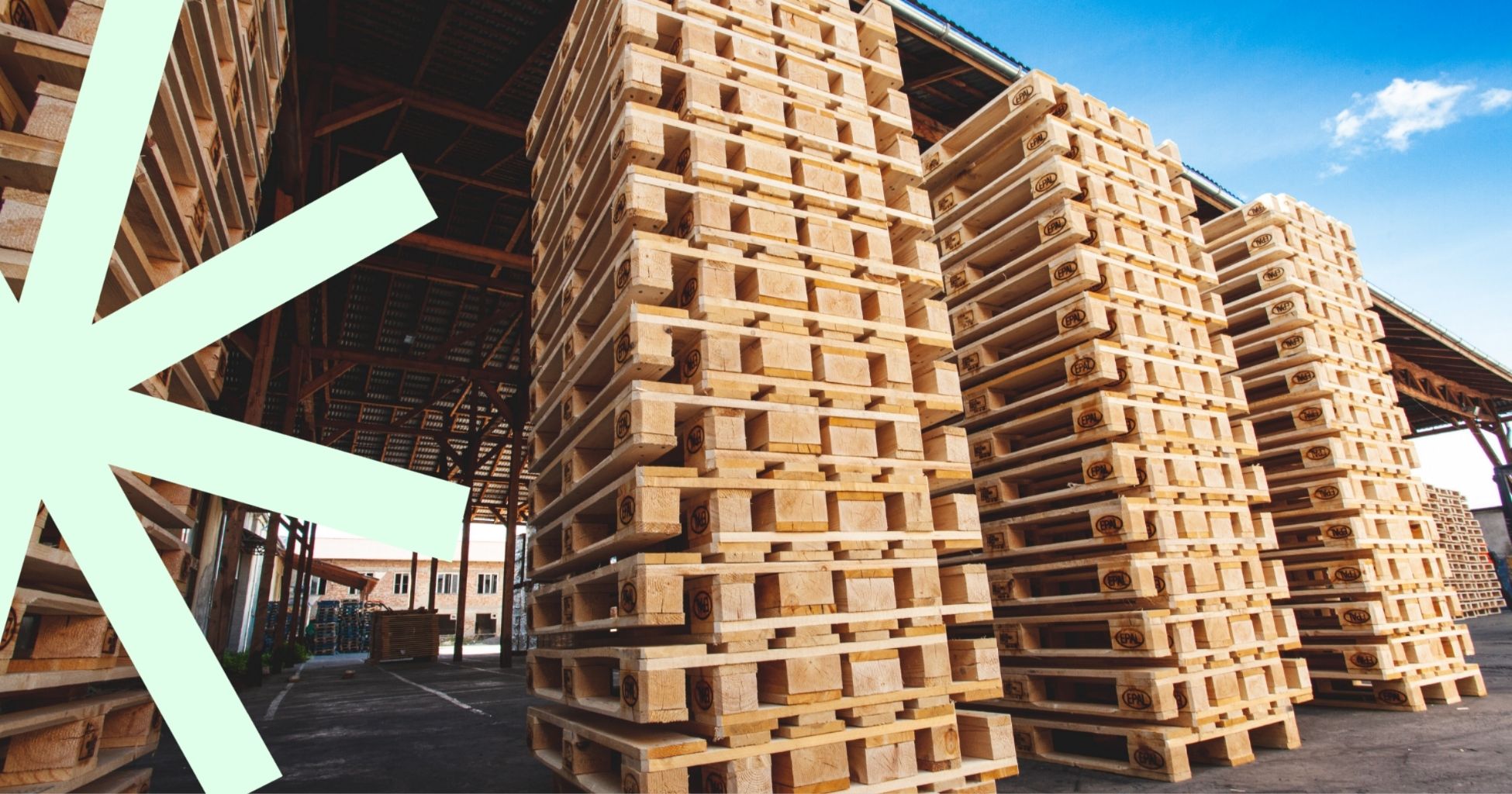
It can be found in every warehouse, on every lorry, and now even as a coffee table in many a living room: the Euro pallet. According to EPAL, around 670 million EPAL Euro pallets are currently in circulation. No other load carrier in Europe is so widely used.
The reason for this is simple: their dimensions are standardised. Whether in Vienna, Hamburg or Milan, every Euro pallet fits on every rack, on every forklift and on every lorry. Here you can find out what makes them unique, how much they cost and what you should look out for.

THE EURO PALLET – STANDARDISED, ROBUST AND VERSATILE.
Dimensions and weight of the Euro pallet
The base area of 1.2 x 0.8 m is no coincidence. It is specifically designed to ensure that pallets fit optimally onto lorries and into containers. A standard semi-trailer with a load length of 13.6 m can accommodate 33 Euro pallets.
Property | Value |
|---|---|
Length x Width | 1,200 x 800 mm |
Height | 144 mm |
Tare weight | approx. 25 kg |
Load capacity (payload) | up to 1,500 kg |
Stacking load | up to 4,000 kg on the bottom pallet |
Structure | 11 boards, 9 blocks, 78 special nails |
Material | Wood, heat-treated |
TESTIMONIALS
What our clients say

SALU HOME
"Especially since we have shifted our focus entirely to the online shop, the reliability and fast delivery times have become invaluable to us."
Anna & Sarira Krüger
Co-Founder & Creative Director
Standards and markings: How do you recognise a genuine EPAL Euro pallet?
The Euro pallet was originally standardised by the European railways. Today, it is specified in DIN EN 13698-1. Quality and licensing are overseen by the European Pallet Association (EPAL), which celebrates its 35th anniversary in 2026.
You can recognise a genuine Euro pallet by three characteristics on the blocks of the long side:
Left and right corner blocks: the oval EPAL logo. Older pallets may still carry the "EUR" marking on the left.
Centre block: the IPPC mark with the "HT" designation (heat-treated according to the international ISPM 15 standard), country code, manufacturer's licence number, as well as the year and month of production.
Control staple: a metal staple on the centre block indicating that the pallet originates from a licensed manufacturer.
If the marking is missing or illegible, the pallet is not considered exchangeable.

Standard sizes and dimensions of the Euro pallet.
Quality grades: new, A, B and C
All classes are exchangeable, provided the pallet is undamaged and correctly marked. Used Euro-palettes are categorised into classes based on their condition:
Class | Condition | Typical Use |
|---|---|---|
New | Unused, freshly produced | Food, pharmaceuticals, high requirements |
Class A | Light, minimal signs of wear | Retail, shipping with visual requirements |
Class B | Darkened, slightly soiled, fully functional | Standard transport and warehousing |
Class C | Clearly used, soiled, but intact | Internal transport, warehousing |
Euro-palette, half-pallet, industrial pallet: the differences
Pallet Type | Dimensions (L x W) | Special Feature |
|---|---|---|
Euro-palette (EPAL 1) | 1,200 x 800 mm | The standard in Europe, exchangeable |
Industrial pallet (EPAL 2) | 1,200 x 1,000 mm | Wider, for large and heavy goods |
Half-pallet (EPAL 6) | 800 x 600 mm | Ideal for retail displays |
Quarter-pallet | 600 x 400 mm | For small quantities and promotional goods |
Single-use pallet | variable | Inexpensive, non-standardised, non-exchangeable |
Plastic pallet | typically 1,200 x 800 mm | Hygienic, durable, significantly more expensive |
How much does a Euro-palette cost?
The price fluctuates with wood prices, energy, and demand. In the summer of 2026, the benchmark price for a new EPAL Euro-palette in the DACH region was around 12 EUR net per pallet. Used pallets are usually 3 to 5 EUR cheaper, depending on their class. Prices for new pallets are under pressure in 2026, driven primarily by rising costs for timber, kiln-drying, and personnel.
Small quantities purchased from retailers often cost more, whilst large orders attract discounts. For your budget, considering a pallet exchange scheme is highly worthwhile.
Pallet exchange: How does it work?
The Euro-palette is part of an open exchange system. The principle is simple: whoever delivers a loaded pallet receives an empty, equivalent one in return. This is also referred to as a one-for-one exchange. As a result, pallets circulate throughout Europe for years, without individual shippers constantly having to purchase new ones.
Crucial for your operations: clarify before every transport whether pallets will be exchanged, and record the exchange on the delivery note. If no exchange takes place, a pallet balance is created, which must be settled or paid for later.
Euro-palettes at GMLogistics
Whether it is warehousing, B2B delivery, or transport: at GMLogistics, we move goods on Euro-palettes daily. We store your pallets in our warehouse in Vienna, pick and pack your orders from them, and organise national as well as international transport.
Do you need storage space or a partner for your pallet shipments? We would be pleased to advise you.
Sources: GMLogistics, EPAL, Tacto

